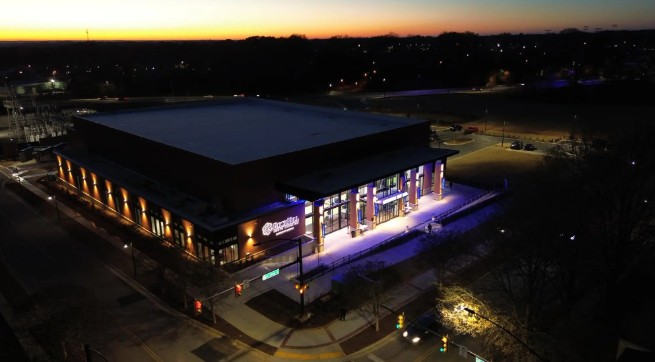
Sports tourism is big business — and getting bigger every year —as cities in every corner of South Carolina recognize the economic and quality-of-life impacts of recreation centers.
The City of Rock Hill was one of the first cities in the state to see the importance and value in sports tourism, starting in the 1980s. It has kept up the momentum in the decades since.
Mark Sexton, the city’s director of parks, recreation and tourism explains that the move to diversify after the textile industry was starting to go away, was highly controversial. “When they built Cherry Park in the ‘80s, it was a four-to-three vote on city council. And if that facility had not been successful, I don’t think anything we’re talking about [now] would have happened.”
But Cherry Park — a 68-acre complex built primarily for baseball and softball — was highly successful. Its pinwheel design, with fields spread around a tower placed in the middle, was among the first of its kind in the Southeast. Now, designs of this type are everywhere.
“That started the softball and baseball push for sports tourism and we hosted some very large events — the [National Softball Association] World Series, some Dixie Boys World Series, upwards of 688 teams from all over United States and Canada,” Sexton said.
That led to an additional facility with four more baseball fields across the street. Then, a tennis center. In 2006, Manchester Meadows, a 68-acre park opened for large-scale, high-profile soccer tournaments. The venue hosted national tournaments, soccer, lacrosse, Quidditch World Championships and rugby.”
The next frontier was cycling — with the Velodrome opening in 2012 and a BMX super cross track in 2014. 2019 saw the arrival of the Rock Hill Sports and Events Center, a 170,000-sf facility near downtown used primarily for basketball and volleyball, also features event space including boxing and gymnastics.
Add to the list in 2025, Rock Hill’s Bleachery Fieldhouse has four basketball courts that can serve as eight volleyball courts, and 12 pickleball courts.
Last but not least, the city is now in the design stage of a new 80-plus acre regional park.
Sexton said Rock Hill’s success —with a direct economic impact growing from $43 million in 2005 – 2009 to $407 million from 2020 – 2024 — can be linked to several things, including the addition of “tourism” to the parks and recreation department name in 1988. That made the department the destination marketing organization for the City of Rock Hill, providing it the authority to market and sell the city’s facilities to outside organizations.
Article content is sourced from: UPTOWN – a publication of the Municipal Association of South Carolina, April 2026 edition
If you are curious about what your home is worth or if it’s a good time for you to buy or sell, give us a call at 803-831-8588. We would love to share our perspective on Lake Wylie and the Charlotte area.

Leave a Reply